
 Login
Login Register



About the course
This interdisciplinary master’s develops advanced skills at the intersection of electrical engineering, computer science and neuroscience to design and apply neuromorphic technologies. You’ll work with cutting-edge sensors, hardware and algorithms, and can complete an applied or research project with industry and the International Centre for Neuromorphic Systems (MARCS Institute). The course builds capability for smart edge devices and brain-inspired computing in a structured, hands-on way for Master-level engineering practice.
Career outcome
Graduates can pursue roles across emerging neuromorphic and intelligent-systems industries, applying brain-inspired sensing and computing to real-world problems. Career pathways include artificial intelligence and machine learning, robotics and mechatronics, computational neuroscience, electronics engineering, biomedical engineering and signal processing. This Master-level engineering qualification supports work in R&D teams, product development and advanced technology groups focused on next-generation hardware–software systems.
Career outcome
Upon graduating from this program, you may be employed in roles such as biomedical engineer, academic, maritime engineer, policy maker, petroleum engineer, environmental engineer, and etc. in companies including ExxonMobil, General Motors, Volkswagen Group, Samsung Electronics, General Electric, and etc.Living Costs in Parramatta**

Restaurant (Meal, Inexpensive Restaurant) A$ 17 - 22 |

Rent per Month (1 bedroom in City Centre) A$ 2,174 - 2,875 |

Rent per Month (1 bedroom Outside of Centre) A$ 1,562 - 2,066 |

Transportation (Daily) A$ 8 - 10 |

Utilities per Month (Electricity, Mobile & Internet) A$ 242 - 320 |
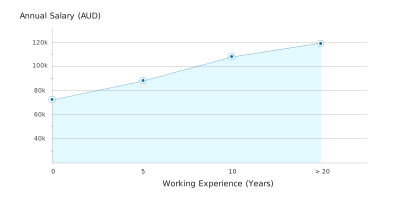
Average Salary***
**Source: numbeo.com
***Source: payscale.com