 Register
 Login
Login



Last updated: 30 Jul 2026 · By AUG Student Services
Introduction
Everywhere you look at the news, TikTok, family WhatsApp groups, someone is saying “AI will take all the jobs.” As a parent, you worry: “If my child studies for 3–4 years, will that job still exist after graduation?” The honest answer: AI is changing jobs, but it is not making all degrees useless. Some careers will shrink. Many more will grow or change. This guide explains it in simple English, what AI really means for jobs, and which degrees are safer bets in 2026 and beyond.
Why This Matters
A degree is a big investment often RM90,000 to RM800,000 depending on where your child studies.
Choosing a course only because it is “popular now” can be risky if AI automates that work later.
The good news: research shows AI will create more jobs than it removes the World Economic Forum expects about 170 million new jobs and 92 million displaced jobs by 2030, a net gain of 78 million (Future of Jobs Report 2025)
Main Topic: What Is AI Actually Doing to Jobs?
Think of AI like a very fast assistant. It is best at repetitive, predictable tasks. It is weak at jobs that need human touch, judgement, creativity, and physical skill. So instead of “AI replaces jobs”, the more accurate picture is:
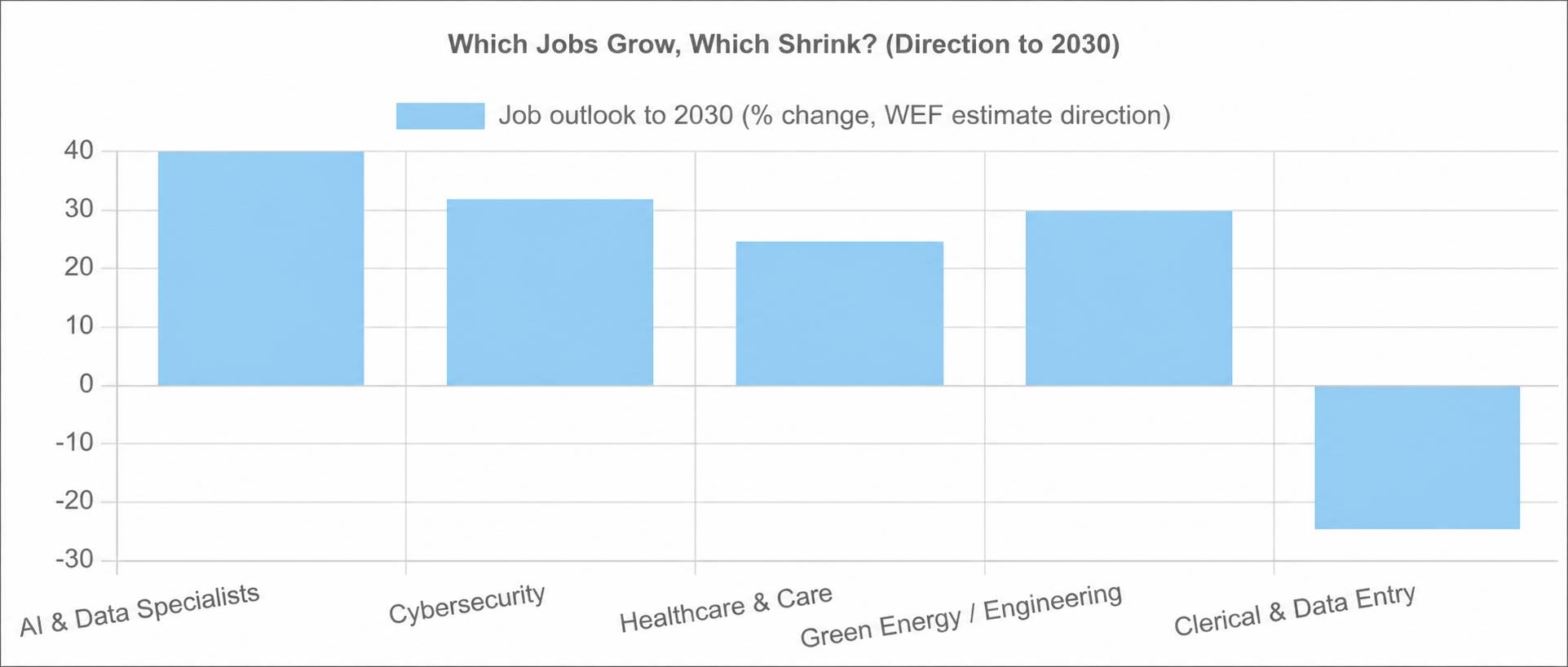
Jobs at risk: routine work basic data entry, simple clerical work, basic bookkeeping, telemarketing.
Jobs changing: most office jobs accountants, marketers, engineers and doctors will all use AI daily, not be replaced by it.
Jobs growing: AI & data specialists, cybersecurity, healthcare, teaching, green energy, skilled trades and care work.
Simple rule for parents: AI replaces tasks, not whole careers. People who know how to use AI will replace people who don’t.
Supporting Information: Which Degrees Are More Future-Proof?
| Degree Area | Future Outlook | Why It’s Safer |
| Computer Science / AI / Data | Very strong | Someone must build, manage and check AI |
| Cybersecurity | Very strong | More AI = more digital risk to protect against |
| Healthcare (Nursing, Medicine, Allied Health) | Very strong | Human care can’t be automated; ageing population |
| Engineering (Green Energy, Robotics) | Strong | Physical + technical skills; energy transition |
| Education & Psychology | Strong | Human connection is the core of the job |
| Business + Digital Skills | Strong (if combined with tech) | Strategy, leadership and people skills stay human |
| Accounting / Admin (traditional only) | Changing fast | Routine tasks automated — must add analytics/AI skills |
| Pure clerical / data entry studies | Declining | Highly repetitive — most exposed to automation |
Latest Facts (2026)
Net job growth, not job loss: WEF projects 170 million new roles vs 92 million displaced by 2030, a net gain of ~78 million jobs.
Fastest-growing skills: AI & big data, cybersecurity, and technological literacy top the list alongside human skills like creative thinking, resilience and leadership.
Employers are retraining, not just replacing: most employers surveyed plan to reskill their workforce for AI, meaning graduates who can learn continuously stay employable.
Malaysia context: national digital-economy plans (e.g. data centres, semiconductor and AI investment) are increasing local demand for tech, engineering and data graduates.
(Note before publishing: please let our team verify and add 2–3 fresh Malaysia-specific 2026 statistics — e.g. MDEC/TalentCorp reports — with live links, following the same source format as our previous article.)
AUG Expert Insights: How We Advise Families in Nationwide
Don’t ask “Which job is safe?” Ask “Which skills are safe?” Degrees that mix technical skills + people skills last the longest.
Any degree + AI literacy > a “trendy” degree alone. An accounting student who learns data analytics is more future-proof than one who avoids technology.
Follow your child’s strengths, not fear. A student forced into computer science who hates it will do worse than a passionate nursing or design student.
Choose universities that embed AI in every course many of our partner universities in Australia, the UK, Malaysia and beyond now teach AI tools across business, health and engineering programmes.
Frequently Asked Questions
Will AI make my child’s degree useless? No. Degrees teach thinking, discipline and problem-solving. But the degree should include digital/AI skills.
Is computer science the only safe choice? No. Healthcare, engineering, education and skilled trades are also strong and not everyone should code.
My child loves art/design. Is that risky? Creative careers are changing, not disappearing. Designers who use AI tools are in demand.
Should we choose the course based on job trends alone? No, combine three things: your child’s strengths, job outlook, and budget. AUG helps map all three for free.
Is it better to study these degrees in Malaysia or overseas? Both works see our companion guide on Malaysia vs overseas costs, or ask us to compare specific universities for your chosen field.
Summary
AI is changing jobs faster than it is removing them the world expects a net gain of jobs by 2030.
Safest degrees combine technology + human skills: healthcare, AI/data, cybersecurity, engineering, education, and business-with-digital.
The real risk is not AI, it is graduating without AI skills. Choose a course and university that teaches them.
Call-to-Action: Talk to Us — It’s Free
Not sure which degree fits your child’s strengths and the 2030 job market? Visit the AUG Kuantan office or any AUG branch nationwide for a free consultation. We’ll match your child’s results and interests to future-proof courses in Malaysia and overseas with real costs, real intakes and honest advice. AUG counselling is free because we are officially appointed representatives of our partner universities.