 Đăng ký
 Đăng nhập


 Last updated: 30 Jul 2026 | By AUG Student Services Malaysia Certified Education Counsellors with 25+ years of experience placing Malaysian students locally and abroad.
Giới thiệu
Your SPM or STPM results are finally out. Around the dinner table, one question keeps coming up: should you stay in Malaysia, or go overseas?
It’s a question thousands of Malaysian families wrestle with every year and in 2026, the answer is less obvious than ever. Malaysian universities are climbing world rankings, the ringgit makes overseas study more expensive, yet countries like Australia and the UK still offer powerful post-study work opportunities.
At AUG Student Services, our counsellors across Malaysia from Kuala Lumpur and Penang to Johor Bahru, Ipoh, Kuantan, Kota Kinabalu and Kuching sit with families having this exact conversation every day. This guide gives you the honest, side-by-side comparison we walk through in our consultations.
Why This Decision Matters More Than Ever in 2026
For most families, education is the biggest financial commitment after buying a home often RM100,000 to RM800,000 over a full degree
Visa rules, tuition fees and post-study work rights are changing every year in major destinations
Malaysia is no longer just the “budget option” it is becoming a genuine global education hub with world-ranked universities and international branch campuses
The wrong choice can cost not just money, but time, confidence and career momentum
Malaysia vs Overseas: The 2026 Comparison
| Factor | Study in Malaysia | Study Overseas (Australia/UK/etc.) |
| Tuition per year | RM10k–30k (public); RM30k–90k (private/branch campus) | Approx. RM90k–160k+ (AUD 20k–50k+ / GBP 15k–30k+) |
| Living costs | RM1,500–3,000/month total | RM6,000–10,000+/month; Australia requires min. AUD 29,710/yr in funds |
| World rankings | UM at #58 in QS 2026; several in top 300 | Wider choice of top-50 universities |
| Family & culture | Close to home, same time zone, halal food everywhere | Independence, global exposure, new networks |
| Post-study pathway | Growing local and ASEAN job market | Post-study work visas (2–4 years, varies by country) |
| Total 3-year degree cost | Approx. RM90k–330k | Approx. RM400k–800k+ |
Cost: Where Malaysia Wins Clearly
For parents, this is usually the first question and rightly so. A full private degree in Malaysia often costs less than one year of study in Australia or the UK once you include tuition, rent, food, flights and insurance.
Hidden overseas costs families often forget:
Visa fees: Australia’s student visa is now approx. AUD 1,600 (over RM4,700)
Health insurance: compulsory in most destinations (e.g. OSHC in Australia)
Flights home: RM2,000–5,000 per trip, once or twice a year
Currency swings a weaker ringgit can add tens of thousands over a degree
Quality & Rankings: The Gap Is Closing
The old assumption that “overseas is automatically better” no longer holds:
Universiti Malaya reached #58 in the QS World University Rankings 2026 — Malaysia’s first top-60 university and 16th in Asia — UM climbs to 58th in QS worl…
Sunway University was among the biggest climbers globally in QS 2026, rising over 120 places — QS World University Rankings…
Malaysia hosts full branch campuses of Monash, Nottingham, Southampton, Heriot-Watt and Swinburne — the same degree certificate, at Malaysian prices
Malaysia’s international student numbers are forecast to grow ~8.5% annually to around 260,000 by 2030, a sign of rising global confidence Malaysia’s next global test:…
That said, if your target is a global top-50 university, a specialised course not offered locally, or an academic research career, overseas study still offers more options.
Career & Post-Study Opportunities
Overseas: Australia offers post-study work visas of 2–4 years; the UK offers a 2-year Graduate Route. Overseas work experience commands a premium with many employers.
Malaysia: Strong and growing demand in tech, finance, healthcare and engineering; multinationals in KL, Penang and Johor actively recruit local graduates — with no visa uncertainty.
Reality check: post-study work rights are opportunities, not guarantees. Course choice and internships matter more than location alone.
The Hybrid Option: Best of Both Worlds
Many families we counsel choose a middle path and it’s often the smartest financially:
Twinning / 2+1 programmes: 2 years in Malaysia + 1 year abroad. Same overseas degree, at a fraction of the cost.
Branch campuses: a Monash or Nottingham degree, entirely in Malaysia.
Local bachelor’s, overseas master’s: save at undergraduate level, invest in a 1-year overseas postgraduate degree later.
Foundation locally, degree abroad: lets younger students mature at home first.
The Non-Financial Factors Parents Ask About Most
Readiness: Can your child cook, budget and manage time alone? An 18-year-old and a 21-year-old are very different travellers.
Homesickness: Real and common in the first semester abroad but most students adapt within 3–6 months.
Food & faith: Halal food and prayer facilities are easy in Malaysia; abroad, availability varies by city (major Australian and UK cities are generally well-served).
Safety: Both options are broadly safe; the bigger risk is usually an unprepared student, not an unsafe country.
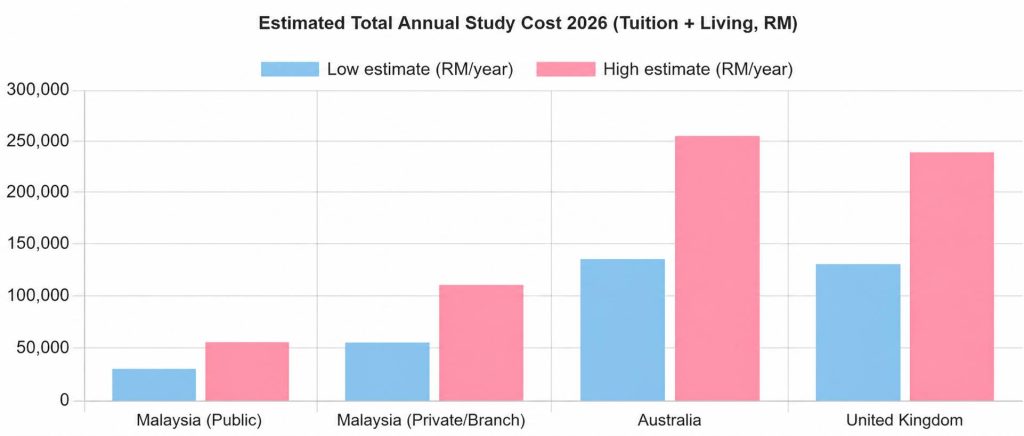
Estimated Total Annual Cost 2026 (Chart)
Estimates based on published 2026 fee and living-cost data; actual costs vary by course, university and city. Sources: Cost of Studying in Malaysia… and Cost of Studying in Australi…
AUG Expert Insights: How We Advise Families
After 25+ years and tens of thousands of placements across our Malaysian offices, our counsellors use a simple four-step framework:
Budget: What can your family comfortably invest over 3–5 years, with a 15–20% buffer for currency and fee increases?
Course: Is the programme (and its accreditation, e.g. medicine, engineering, law) strong locally, or genuinely better abroad?
Career goal: Where does your child want to work at 25? Local, ASEAN or global?
Readiness: Is your child independent enough now, or would a local start (foundation/twinning) build that maturity first?
Two real outcomes we see often (details anonymised):
Student A chose a 2+1 twinning programme: two years in KL, final year in Australia. Total cost: roughly half of a full overseas degree, same Australian degree certificate, and she secured a graduate role in Melbourne.
Student B stayed at a Malaysian branch campus for engineering, graduated debt-free, and joined a multinational in Penang earning while his overseas-educated peers were still repaying loans.
Neither path was “wrong”. They matched different budgets, personalities and goals, which is exactly the point.
Các câu hỏi thường gặp
- Is a Malaysian degree recognised overseas?
Yes, degrees from MQA-accredited Malaysian universities and international branch campuses are widely recognised. For regulated professions (medicine, law, engineering), check the specific professional body of the country where you intend to work. - Can I start in Malaysia and transfer abroad?
Yes. Twinning (2+1, 1+2) and credit transfer programmes are well established. AUG can map exact transfer pathways to partner universities in Australia, the UK and beyond. - How much should we budget in total?
As a rough guide for a 3-year degree: RM90k–330k in Malaysia versus RM400k–800k+ overseas, including living costs. Always add a buffer for currency movement. - Are scholarships easier to get locally or overseas?
Both exist. Malaysian private universities offer generous merit scholarships (often 25–100% tuition). Overseas scholarships are competitive but real many partner universities offer automatic international merit awards. Ask AUG which you qualify for; our service is free. - What if my child isn’t ready to live alone abroad?
Start local. A foundation year or the first two years of a twinning programme in Malaysia builds independence with a safety net then transfer abroad at 20 or 21, far better prepared.
Summary: There Is No Single “Better” — Only Better for Your Family
Choose Malaysia if budget is the priority, the course is strong locally, or your child benefits from staying closer to home, you’ll get rising world-class quality at exceptional value.
Choose overseas if you’re targeting top-50 universities, global networks, immersion in English-speaking environments, or post-study work rights abroad.
Choose a hybrid pathway (twinning, branch campus, local-then-abroad) if you want overseas outcomes at a significantly lower cost, the option most families overlook.
Talk to AUG — Free Consultation, Nationwide
Still weighing your options? Let us map out both pathways side by side with real 2026 costs, real timelines and real university offers.
AUG Student Services has offices across Malaysia: Kuala Lumpur, Penang, Johor Bahru, Ipoh, Kuantan, Kota Kinabalu and Kuching and our counselling is completely free. We are official representatives of universities in Malaysia, Australia, the UK, and more.
Walk in to your nearest AUG office
WhatsApp or call us to book a free session (online or in person)
Bring your results, we’ll shortlist realistic options on the spot
Disclosure: AUG Student Services officially represents partner universities in Malaysia and overseas. Our advice is free to students and families, and we present both local and overseas options honestly including the downsides.