 登记
登记 登录
登录


 Updated: 14 August 2026 | By AUG Student Services
How to Budget as a University Student in Kuala Lumpur, Malaysia
介绍
Kuala Lumpur is one of Southeast Asia’s most exciting student cities. It combines world-class universities, a famously diverse food scene, an ever-expanding public transport network, and a cost of living that remains lower than many comparable capital cities in the region. For thousands of local and international students, KL represents the perfect balance of opportunity and affordability.
That said, “affordable” does not mean “effortless.” City living comes with recurring costs like rent, meals, transport, utilities, and the occasional weekend outing that can quietly accumulate if left unmonitored. The difference between a stressful semester and a comfortable one often comes down to a simple, realistic budget set up in the first few weeks of university life.
This guide breaks down the typical monthly living costs for students in Kuala Lumpur, category by category, and shares practical strategies to stretch every ringgit further.
Why This Matters
Budgeting is one of the most valuable life skills a student can develop, and university is the ideal training ground. Here is why getting your finances right in KL matters:
Financial stress affects academic performance. Students worried about money are more likely to lose focus, take on excessive part-time work, or skip meals. All of which impact grades and wellbeing.
Costs vary dramatically by lifestyle. Two students at the same university can spend RM1,500 and RM3,000 per month respectively, purely based on daily choices around food, housing, and transport.
Habits formed now last a lifetime. Learning to track spending, prioritise needs over wants, and plan ahead builds financial discipline that carries into your working life.
For international students, budgeting affects visa and family planning. Understanding real costs helps families abroad plan remittances accurately and avoid mid-semester shortfalls.
Main Topic: Typical Monthly Living Costs in Kuala Lumpur
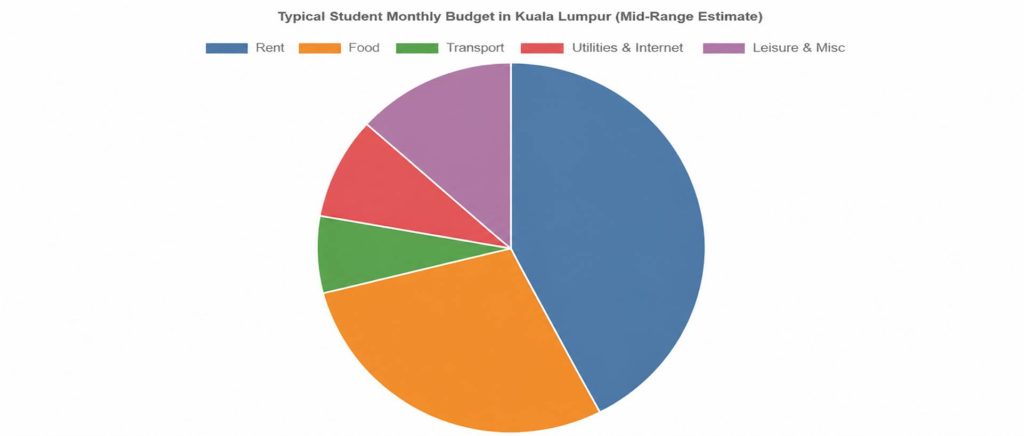
Most students in Kuala Lumpur spend around RM1,500 to RM2,500 per month, assuming shared housing and a moderate lifestyle. For reference, cost-of-living databases such as Numbeo estimate average single-person monthly expenses (excluding rent) at approximately RM2,500 though students typically spend less thanks to shared accommodation, campus facilities, and student discounts.
Let’s break this down category by category.
1. Accommodation (RM700–1,200/month)
Rent is usually the largest fixed expense. Shared rooms or units near campuses or in well-connected suburbs typically cost RM700–1,200 per month. Living slightly further from the city centre but near an LRT or MRT station often delivers the best value, cutting rent significantly while keeping commutes manageable.
2. Meal Budget (RM500–800/month)
Food usually takes the biggest share of a student’s flexible spending but Kuala Lumpur is famously kind to hungry students on a budget:
Food courts and mamak stalls: RM6–10 per meal
Cafes and restaurants: RM20+ per dish
Home cooking: Sharing groceries and cooking with housemates can save up to 30% of your monthly food budget
A sustainable approach is mixing all three: mamak and food court meals on busy weekdays, home-cooked dinners a few nights a week, and cafes reserved for occasional treats.
3. Transport Budget (RM100–200/month)
Relying on e-hailing services like Grab for daily commutes can quickly drain a student wallet. Fortunately, KL’s public transport offers excellent student-friendly options:
RapidKL Student Concession Pass: RM15 per purchase (top-up required), offering discounted fares
My50 Unlimited Travel Pass: RM50/month for unlimited rides across the RapidKL network
Location strategy: Staying near campus or a train station dramatically reduces transport costs
Driving: Petrol, parking, and tolls add up quickly, split costs with friends if driving is unavoidable
4. Utilities and Internet (RM150–250/month)
Utilities like electricity, water, Wi-Fi, and occasional maintenance fees, typically total RM150–250 per month per household. Since these are usually split among housemates, your individual share is often far lower, making shared living one of the smartest budget decisions in KL.
5. Lifestyle and Miscellaneous Spending (RM200–400/month)
This is the most flexible category, covering shopping, outings, subscriptions, and hobbies. Students typically spend RM200–400 per month depending on lifestyle. To keep it under control:
Split streaming subscriptions with friends
Look out for free or low-cost events on campus
Track leisure expenses weekly to avoid overspending
Supporting Information: Example Budget Plan
| 类别 | Budget (RM) | Notes |
| Rent | 700–1,200 | Shared rooms near campus or suburbs |
| Food | 500–800 | Mix of cooking, street food & cafes |
| Transport | 100–200 | LRT/MRT + some e-hailing or petrol |
| Utilities & Internet | 150–250 | Shared among housemates |
| Leisure & Miscellaneous | 200–400 | Shopping, events, campus life |
| 全部的 | ~1,700–2,800 | Depending on lifestyle |
Practical Tips: Things to Consider When Managing Your Student Budget
Beyond the numbers, here are some broader principles worth keeping in mind as you plan your finances in KL:
Follow a simple budgeting framework. The 50/30/20 rule works well for students: roughly 50% on needs (rent, food, transport), 30% on wants (leisure, shopping), and 20% saved or kept as an emergency buffer.
Choose your location strategically. Accommodation near a train station may cost slightly more in rent but can save significant transport money and time, always calculate rent and transport together.
Build a small emergency fund. Even RM50–100 set aside monthly builds a cushion for unexpected costs like laptop repairs, medical bills, or textbook purchases.
Use free tools to track spending. A basic spreadsheet or a free budgeting app takes minutes to update and reveals exactly where your money goes each week.
Maximise your student status. From transport passes to cinema tickets, student rates exist almost everywhere but only if you ask and carry proof.
Review your budget every semester. Costs change as your timetable, housing, and habits evolve. A quick review each semester keeps your plan realistic.
Balance saving with living. Budgeting is not about deprivation. Allocate a guilt-free leisure amount each month so you enjoy student life without financial anxiety.
经常问的问题
How much does a student need per month in Kuala Lumpur?
Most students spend between RM1,500 and RM2,500 per month with shared housing and a moderate lifestyle. A comfortable upper range, including all categories, is around RM2,800.
Is Kuala Lumpur expensive for international students?
Compared to cities like Singapore, Sydney, or London, KL is significantly more affordable. Food, transport, and shared accommodation are all reasonably priced, especially with student discounts.
What is the cheapest way to get around KL as a student?
The My50 Unlimited Travel Pass (RM50/month) offers unlimited RapidKL rides, while the RapidKL Student Concession Pass (RM15 per purchase, top-up required) gives fare discounts. Both are far cheaper than daily e-hailing.
How can I save the most money on food?
Eat at food courts and mamak stalls (RM6–10 per meal) and cook at home with housemates, which can cut food costs by up to 30%. Reserve cafes and restaurants for occasional outings.
Should I share accommodation or live alone?
Sharing is almost always more economical. Shared rooms cost RM700–1,200 monthly, and utilities (RM150–250) become much lighter when split among housemates.
What student discounts are available in KL?
Many cinemas, cafes, and shops offer student rates, and universities typically provide free gyms, shuttle buses, and medical clinics. Always carry your student card as proof.
Summary
Living in Kuala Lumpur as a student does not need to be costly. With rent of RM700–1,200 in shared housing, meals from as little as RM6 at mamak stalls, unlimited public transport for RM50 a month, and shared utilities of RM150–250, a realistic total budget of RM1,700–2,800 per month covers a comfortable student lifestyle. The keys are simple: choose accommodation strategically, mix affordable food options, use student transport passes, take full advantage of student discounts and campus facilities, and track your spending regularly. With careful planning and the right balance, you can make the most of everything KL has to offer while staying financially mindful.
Need Some Guidance?
If you would like personalised advice on affordable universities, accommodation options, or scholarships in Kuala Lumpur, the counsellors at AUG Student Services, we are happy to help, free of charge. Contact AUG学生服务 to start your university journey in Malaysia with confidence.